Certificate Lifecycle Management
(CLM) Solutions
Managing digital certificates across websites, applications, servers, and infrastructure can become increasingly complex as certificate volumes grow and validity periods shorten.
WebNIC offers Certificate Lifecycle Management (CLM) solutions through trusted technology partners to help organisations centralise certificate visibility, automate lifecycle processes, and reduce the operational risks associated with manual certificate management.
Explore CLM solutions designed to support your organisation’s certificate management needs.
Why Is Managing Digital Certificates Becoming More Complex?
Without sufficient visibility and automation, certificate-related tasks may increase operational workload and the risk of unexpected service interruptions.
Shorter Certificate Lifespans
More frequent renewals create additional work for IT teams relying on manual processes.
Limited Certificate Visibility
Certificates distributed across infrastructure may be overlooked without a central inventory.
Certificate Expiration Risks
Expired certificates can trigger security warnings, failed connections, and service disruption.
Fragmented Manual Workflows
Spreadsheets, reminders, and disconnected tools make certificate operations harder to coordinate.
The Business Challenge
What Is Certificate Lifecycle Management (CLM)?
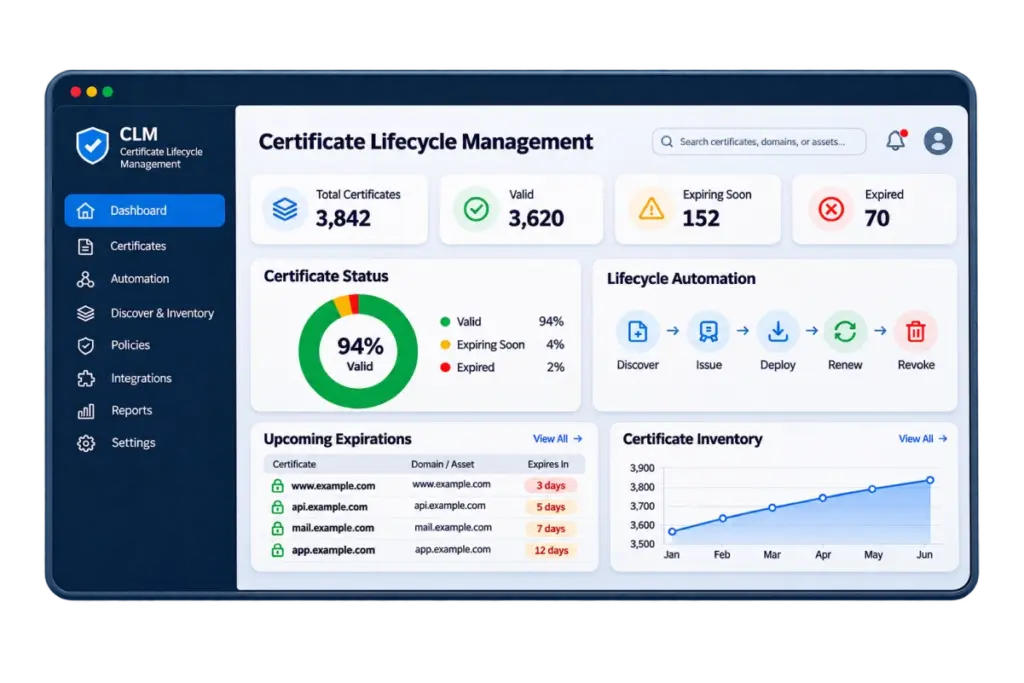
Certificate Lifecycle Management (CLM) is the process of discovering, issuing, deploying, monitoring, renewing, replacing, and revoking digital certificates throughout their lifecycle.
CLM solutions help organisations manage these activities through centralised visibility, defined policies, and automated workflows, reducing manual administration and improving certificate oversight.
CLM can apply to public SSL/TLS certificates, private certificates, and other digital certificate types, depending on the capabilities of the selected platform.
How does CLM Works?
Discover
Identify certificates
Issue
Request and validate
Deploy
Install and configure
Monitor
Track status and expiry
Renew
Replace before expiry
Revoke / Replace
Respond to changes
Why Do Organisations Need
Certificate Lifecycle Management (CLM)?
Centralise Certificate Visibility
Maintain a clearer view of certificate inventories, ownership, validity, and lifecycle status across supported environments.
Automate Repetitive Certificate Tasks
Reduce manual effort through supported workflows for certificate issuance, deployment, renewal, and replacement.
Reduce Certificate-Related Operational Risk
Improve monitoring and renewal planning to help minimise missed expirations and associated service interruptions.
Support Governance and Control
Apply consistent certificate management practices across teams, systems, and certificate authorities where supported.
Prepare for Shorter SSL/TLS Certificate Validity Periods
The public TLS certificate ecosystem is transitioning toward shorter certificate validity periods. As renewals become more frequent, organisations need dependable processes for certificate discovery, monitoring, issuance, and replacement.
Maximum Validity for Publicly Trusted TLS Certificates
CA/Browser Forum schedule approved in April 2025. These limits concern publicly trusted TLS certificates, not every type of digital certificate.
View the official ballot ↗By 2029, publicly trusted TLS certificates will have a maximum validity of 47 days under the approved schedule.
For organisations managing large certificate portfolios, this transition makes automation increasingly important. CLM solutions can help teams prepare by improving certificate visibility and supporting more consistent renewal workflows.
Build a more manageable certificate lifecycle before shorter validity periods become the new normal.
Explore Certificate Lifecycle Management Solutions from WebNIC
Different organisations have different certificate management requirements. Some need centralised visibility across multiple certificate authorities, while others require automation across complex infrastructure, public and private PKI, or broader digital trust environments.
WebNIC offers CLM solutions through technology partners to help organisations evaluate platforms suited to their certificate management objectives.
Sectigo Certificate Manager (SCM)
Centralised, CA-agnostic certificate management
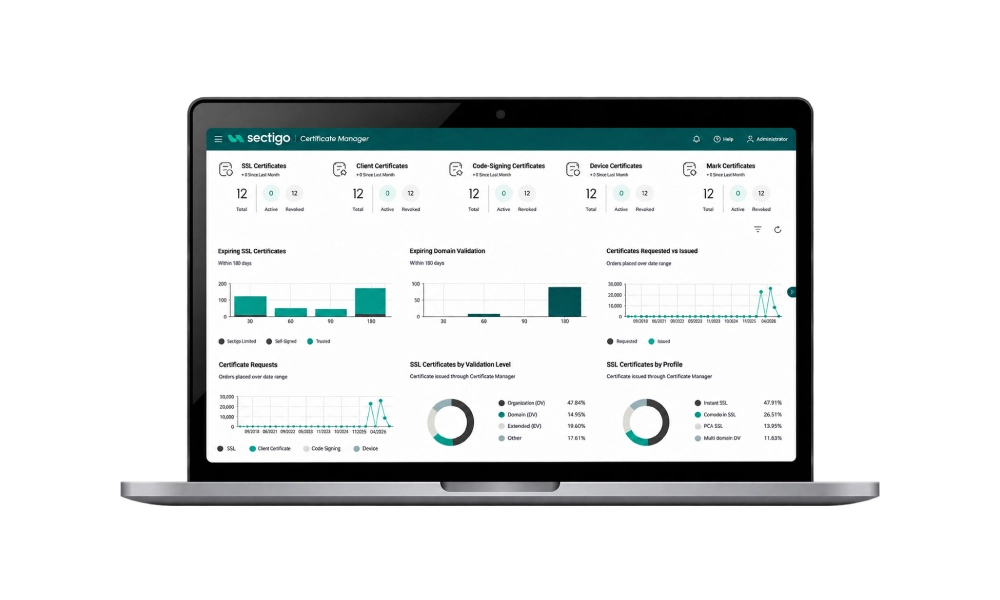
Sectigo Certificate Manager is a CLM platform designed to help organisations discover, manage, and automate digital certificates across supported environments.
Its capabilities include certificate discovery, lifecycle automation, multi-CA management, and support for public and private certificate workflows.
Key capabilities
Feature availability depends on the product configuration and supported integrations.
Explore Sectigo Certificate Manager ↗
DigiCert Trust Lifecycle Manager (TLM)
Certificate lifecycle visibility and automation
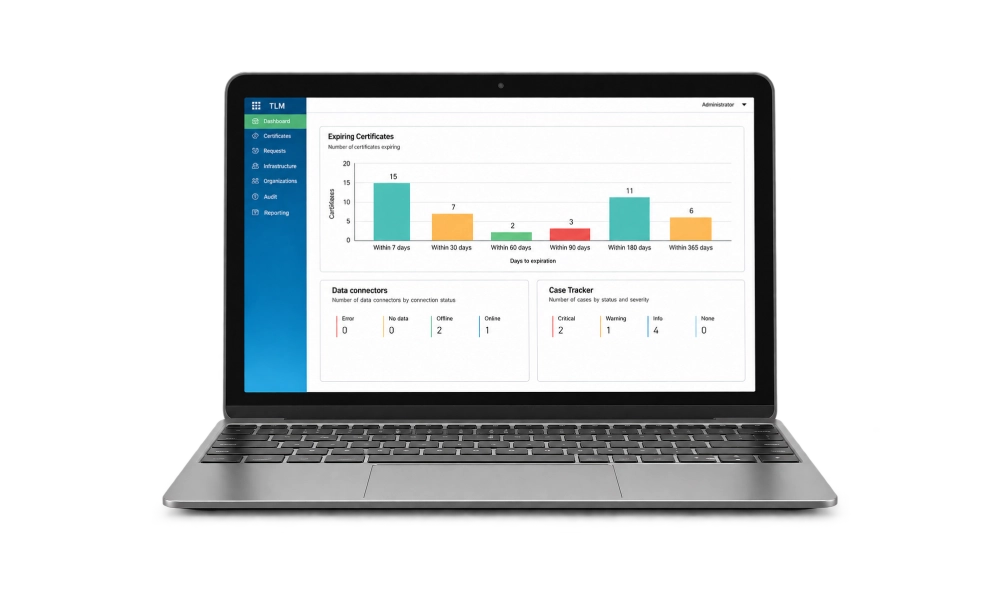
DigiCert Trust Lifecycle Manager helps organisations discover, monitor, and manage digital certificates through centralised workflows and automation.
It is designed to support certificate lifecycle operations, including certificate inventory, renewal planning, deployment workflows, and visibility across supported infrastructure.
Key capabilities
Feature availability depends on the product configuration and supported integrations.
Explore DigiCert Trust Lifecycle Manager ↗CLM4SP
Coming SoonAnother addition to WebNIC's Certificate Lifecycle Management portfolio is planned.
Further product details, capabilities, eligibility, and availability will be announced soon.
Explore CLM4SPChoosing a CLM solution
Certificate environment
Public SSL/TLS, private PKI, internal certificates, and other certificate types
What Is the Difference Between
CLM Solutions and Manual Certificate Management?
| Management area | Manual approach | CLM solutions |
|---|---|---|
| Certificate inventory | Spreadsheets and separate records | Centralised inventory and discovery |
| Expiration tracking | Calendar reminders and manual checks | Monitoring and expiration alerts |
| Certificate issuance | Individual requests and approvals | Supported automated workflows |
| Renewal | Manual tracking and reissuance | Automated or orchestrated renewal |
| Deployment | Individual installation tasks | Supported deployment integrations |
| Visibility | Fragmented across systems | Consolidated certificate oversight |
| Governance | Dependent on local procedures | Centralised controls and reporting |
Capabilities vary by platform, configuration, certificate type, and infrastructure integration.
CLM reduces manual dependencies but does not eliminate the need for monitoring, governance, or technical oversight.
Who Can Benefits from CLM Solutions?
Enterprises
Manage certificate portfolios across business applications, teams, and infrastructure.
IT & Security Teams
Improve certificate visibility, automate supported workflows, and maintain operational oversight.
Cloud & Infrastructure Teams
Coordinate certificate operations across supported cloud, server, and hybrid environments.
MSPs & Technology Partners
Explore certificate management solutions for customers with complex digital certificate requirements.
Frequently Asked Questions
01
What is Certificate Lifecycle Management (CLM)?
Certificate Lifecycle Management (CLM) is the process of discovering, issuing, deploying, monitoring, renewing, replacing, and revoking digital certificates. CLM software helps organisations centralise and automate supported lifecycle activities.
02
Why is Certificate Lifecycle Management important?
CLM helps organisations maintain visibility over their digital certificates, reduce repetitive administration, and lower the risk of service interruptions caused by missed certificate renewals.
03
How does certificate lifecycle automation work?
Certificate lifecycle automation uses supported integrations, protocols, and workflows to manage activities such as certificate requests, issuance, deployment, monitoring, and renewal. The level of automation depends on the platform and environment.
04
What types of certificates can CLM software manage?
Depending on the platform, CLM software may support public SSL/TLS certificates, private certificates, internal PKI certificates, S/MIME certificates, and code signing certificates. Specific support should be verified for each solution.
05
Can CLM software prevent SSL/TLS certificate expiration?
CLM software can reduce the likelihood of missed renewals through discovery, monitoring, alerts, and automation. However, it cannot guarantee that certificates will never expire or that every renewal will succeed.
06
Does CLM support certificates from multiple certificate authorities?
Some CLM platforms support certificates from multiple certificate authorities. Sectigo Certificate Manager offers CA-agnostic management capabilities. Supported providers and workflows depend on the platform configuration.
07
What is the difference between CLM and PKI?
Public Key Infrastructure (PKI) provides the technologies, policies, and processes used to issue and manage digital certificates and cryptographic keys. CLM focuses on managing certificates throughout their operational lifecycle. CLM can operate alongside public or private PKI environments.
08
What is the difference between CLM and ACME?
CLM is a broader certificate management discipline covering discovery, monitoring, issuance, renewal, governance, and other lifecycle activities. ACME is a protocol used to automate certificate issuance and renewal. ACME may be one component of a CLM solution.
09
What CLM solutions does WebNIC offer?
WebNIC's current CLM portfolio includes Sectigo Certificate Manager (SCM), DigiCert Trust Lifecycle Manager (TLM), and CLM4SP.
10
How do I choose between Sectigo SCM, DigiCert TLM and CLM4SP?
Start by reviewing your certificate types, certificate authorities, infrastructure, automation requirements, and integration needs. Compare each platform's supported capabilities and commercial terms before deciding. WebNIC can discuss available options.
11
Is CLM suitable for managed service providers and resellers?
Yes, CLM solutions are relevant to MSPs and resellers serving customers with complex certificate environments. Partner delivery models, management capabilities, and commercial arrangements should be confirmed with WebNIC.
12
How can I get started with Certificate Lifecycle Management?
Begin by identifying your certificate inventory, current renewal processes, operational risks, and automation priorities. Contact WebNIC to explore available CLM solutions and their suitability for your environment.
Explore Certificate Lifecycle Management Solutions with WebNIC
Whether you are looking to expand your product portfolio or explore certificate lifecycle management for your organisation, our team is ready to help.
For Resellers & Channel Partners
As an ICANN-accredited registrar and digital solutions provider, WebNIC supports resellers and technology partners across the domain and digital security ecosystem.
Expand your digital trust portfolio by offering Certificate Lifecycle Management solutions to your customers. Connect with WebNIC to explore our available solutions and partnership opportunities.
For Enterprises & Organisations
Looking to simplify certificate management, improve visibility and automate certificate lifecycles? Speak with our team to discover how CLM solutions can support your organisation’s requirements.