
Every year, billions of dollars are lost to online scams, phishing attacks, impersonation campaigns, and digital fraud. While the financial losses grab headlines, there is another growing concern that affects businesses, brands, registries, and domain owners worldwide: digital brand abuse.
Behind many scams are fraudulent websites, fake social media accounts, spoofed domains, phishing infrastructure, and impersonation campaigns designed to exploit consumer trust. A comparison of recent scam reports from Singapore, Australia, and the United States reveals an important lesson: successful scam prevention increasingly depends on strong digital brand protection measures.
Which countries are successfully fighting scams, and what can others learn from them?
A comparison of Singapore, Australia, and the United States reveals not only how much money consumers are losing, but also how different governments are responding to the growing scam epidemic.
The Global Scam Problem Is Getting Worse
Reported scam losses in 2025 reached alarming levels:
|
Country
|
Reported Scam Losses
|
|---|---|
|
Singapore
|
S$913 million
|
|
Australia
|
A$2.2 billion
|
|
United States
|
US$20.9 billion
|
The Connection Between Scams and Brand Abuse
Most modern scams do not begin with a phone call or email alone.
Instead, cybercriminals frequently leverage trusted brands, websites, domain names, social media platforms, and online services to appear legitimate.
Common tactics include:
- Brand impersonation websites
- Fake customer support pages
- Phishing domains
- Social media impersonation accounts
- Fraudulent advertisements
- Fake investment platforms
- Government impersonation scams
In many cases, scammers succeed because they borrow the credibility of well-known organizations.
For consumers, it can be difficult to distinguish between legitimate services and convincing imitations.

Singapore: Prevention Before Losses Occur
Among the three countries, Singapore stands out as one of the most aggressive and innovative governments in combating scams.
Rather than simply tracking losses, Singapore focuses heavily on:
- Preventing scams
- Disrupting scams in progress
- Recovering stolen funds
This proactive approach appears to be working.
In 2025, Singapore reported both fewer scam cases and lower overall losses compared to the previous year.
Statistics
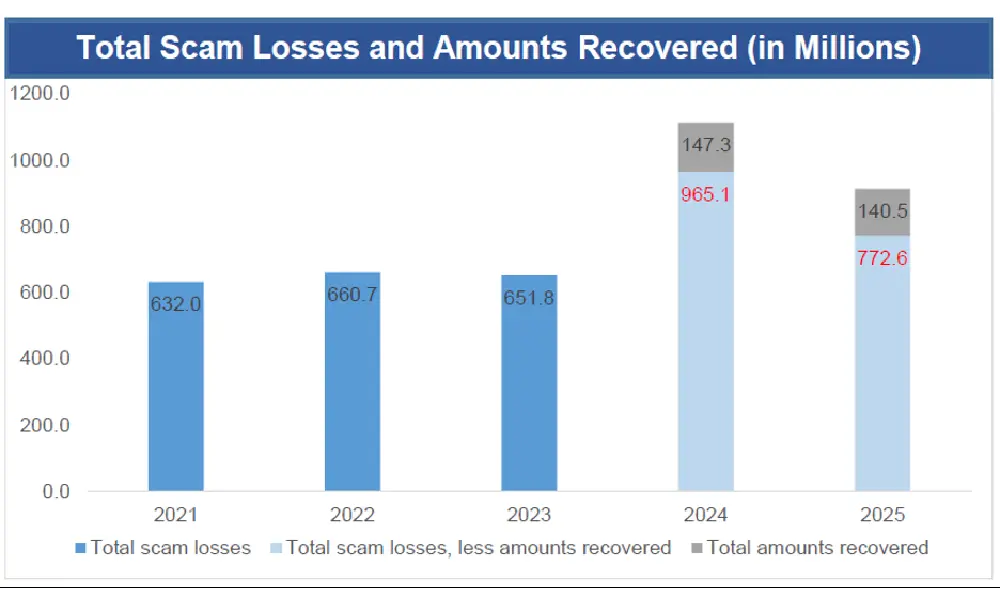
Singapore’s efforts appear to be delivering measurable results. In 2025, both the number of scam cases and total financial losses declined significantly. Reported scam cases fell from 51,504 in 2024 to 37,308 in 2025, while total losses dropped from S$1.1 billion to S$913 million an 18% decrease. One particularly noteworthy development is Singapore’s emphasis on fund recovery. Recent reports not only track scam losses but also highlight the amount of money successfully recovered for victims, reflecting the country’s growing focus on disrupting scams and helping victims recover stolen funds.
(reference: netcraft)
Figure 1. Total Scam Losses and Amounts Recovered. Source: Singapore Police Force Annual Scam and Cybercrime Brief 2025
How Singapore Is Fighting Back
(reference: netcraft)
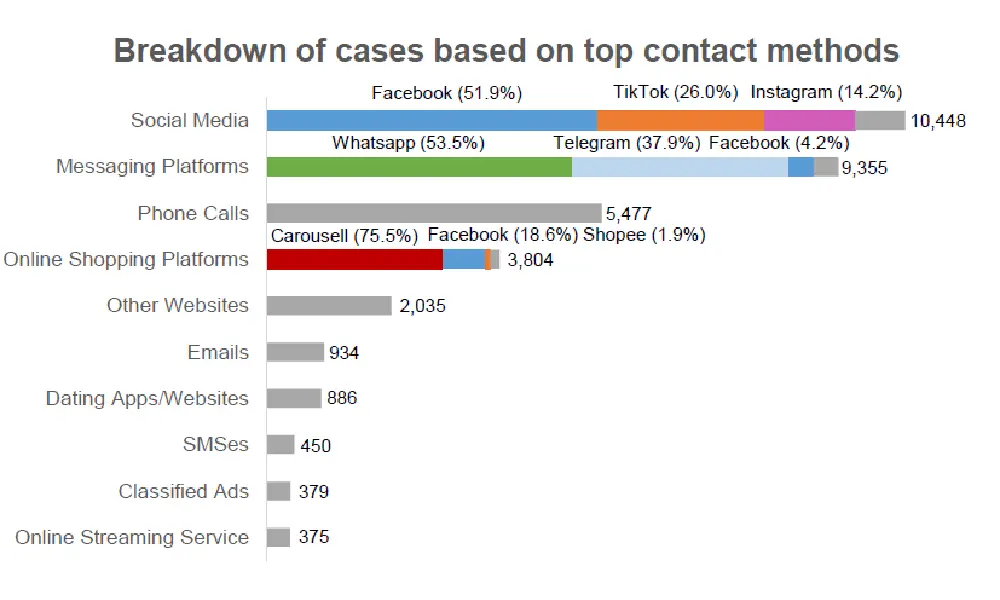
Figure 3. Top Contact Methods by Scammers. Source: Singapore Police Force Annual Scam and Cybercrime Brief 2025
Singapore’s Anti-Scam Command works closely with banks, technology companies, cryptocurrency exchanges, and telecommunications providers to identify scam victims before money is transferred.
Using advanced analytics and real-time monitoring, authorities have been able to:
- Alert potential scam victims before transactions are completed
- Freeze suspicious transfers
- Recover stolen funds
- Disrupt scam websites and phone numbers
One government system reportedly analyzes hundreds of thousands of websites every day and removes tens of thousands of scam sites every month.
Strong Regulations Make a Difference
Singapore has also introduced some of the world’s strongest anti-scam measures, including:
- Mandatory identity verification for certain online advertisements
- Faster removal of scam content
- Enhanced banking security controls
- Scam-blocking tools for consumers
- Strong penalties for money mules and scam facilitators
The result is clear: scam losses fell even as many other countries continued to see increases.

Australia: Progress Through Collaboration
Australia has also taken significant steps to combat scams, although its approach is still evolving. The country’s National Anti-Scam Centre coordinates efforts between regulators, banks, telecommunications providers, and technology companies. While scam losses increased slightly in 2025, Australia continues to strengthen its defenses.
Key Innitiatives
Australian authorities have:
- Removed thousands of scam websites
- Shut down fraudulent social media accounts
- Blocked suspicious phone numbers
- Introduced stronger banking protections
Telecommunications regulators have also implemented anti-scam measures that significantly reduced phone-based scam activity compared to previous years.
Banks across Australia now use additional verification processes and customer protection tools designed to prevent fraudulent transactions before money leaves an account.
Although Australia has made substantial progress, its broader Scam Prevention Framework is still under development and may not be fully implemented until 2027.
The United States: Massive Losses, Limited Prevention
The United States reported by far the highest scam losses among the three countries. According to the FBI’s Internet Crime Complaint Center (IC3), reported losses reached an astonishing US$20.9 billion in 2025. Even more concerning, losses increased by 26% compared to the previous year.
Cryptocurrency Continues to Fuel Fraud
A major driver of scam losses in the United States is cryptocurrency. More than half of reported losses involved digital assets, making cryptocurrency a common payment method in investment scams, romance scams, government impersonation scams, and other forms of fraud.
Artificial Intelligence Is Changing the Scam Landscape
The FBI also highlighted the growing use of artificial intelligence by cybercriminals.
Scammers are increasingly using AI to create:
- Fake social media profiles
- Deepfake videos
- Voice cloning attacks
- Synthetic identities
- Highly convincing phishing campaigns
These technologies allow criminals to scale their operations and make scams harder to detect.
Recovery Efforts Are Improving
Despite the rising losses, US authorities have achieved some notable successes.
Programs such as the FBI’s Financial Fraud Kill Chain and Operation Level Up have helped recover or freeze hundreds of millions of dollars and warn victims before they lose money.
However, compared to Singapore and Australia, the United States still relies more heavily on enforcement and recovery rather than preventative controls.

Why Digital Brand Protection Matters More Than Ever
For businesses, scam prevention is no longer just a cybersecurity issue.
It has become a brand protection issue.
When cybercriminals impersonate a company, customers may lose:
- Money
- Personal information
- Trust in the brand
Even when the business itself is not breached, the reputational damage can be significant.
Organizations today must actively monitor for:
- Typosquatting domains
- Phishing websites
- Social media impersonation
- Fake customer support channels
- Fraudulent advertisements
- Brand misuse across digital platforms

The Future of Scam Prevention
The experiences of Singapore, Australia, and the United States show that scam prevention is evolving beyond traditional cybersecurity defenses.
The most successful approaches increasingly focus on:
- Rapid takedown of phishing domains
- Monitoring brand impersonation
- Platform accountability
- Identity verification
- Cross-industry collaboration
- Real-time threat disruption
As scams become more sophisticated, protecting consumers will require more than awareness campaigns.
It will require protecting the digital identities, domains, brands, and online ecosystems that consumers trust every day.
For organizations operating online, digital brand protection is no longer optional. It is becoming a critical component of modern cybersecurity and customer trust.